Queues
A queue answers one question, and answers it for everybody at once: whose turn is it?
That sounds like a small thing until you count how often a group needs it. Who's on call this week. Who's opening up. Whose turn to bring biscuits. Who speaks next at the AGM. Whose go it is.
Every one of those is currently stored in one person's head, or in a chat message from three weeks ago that nobody can find, and both of those systems fail the moment that person goes on holiday.
Making one
From the initiative's Queues tab, choose Create Queue, give it a name and an optional description, and start adding items with Add Item.
An item is usually a person, but it doesn't have to be — it's whatever takes turns. Tables at a fundraiser, agenda points, sections of a script.
Each item can carry:
| What it's for | |
|---|---|
| Label | What the item is called. Usually a name. |
| Color | So the queue is readable at a glance across a room. |
| Position | Where it sits in the order. Drag to rearrange. |
| Linked member | Link the item to an actual person in your community. |
| Notes | The detail that doesn't fit in a label — "has a key", "vegetarian", "back on the 14th". |
| Tags | The same tags as everything else. |
| Attached | The files and tasks this turn is about, so nobody has to go hunting for it when their turn arrives. Anything from the same initiative that isn't archived. |
| Visible / hidden | Keep somebody in the queue without showing them right now. |
Running one
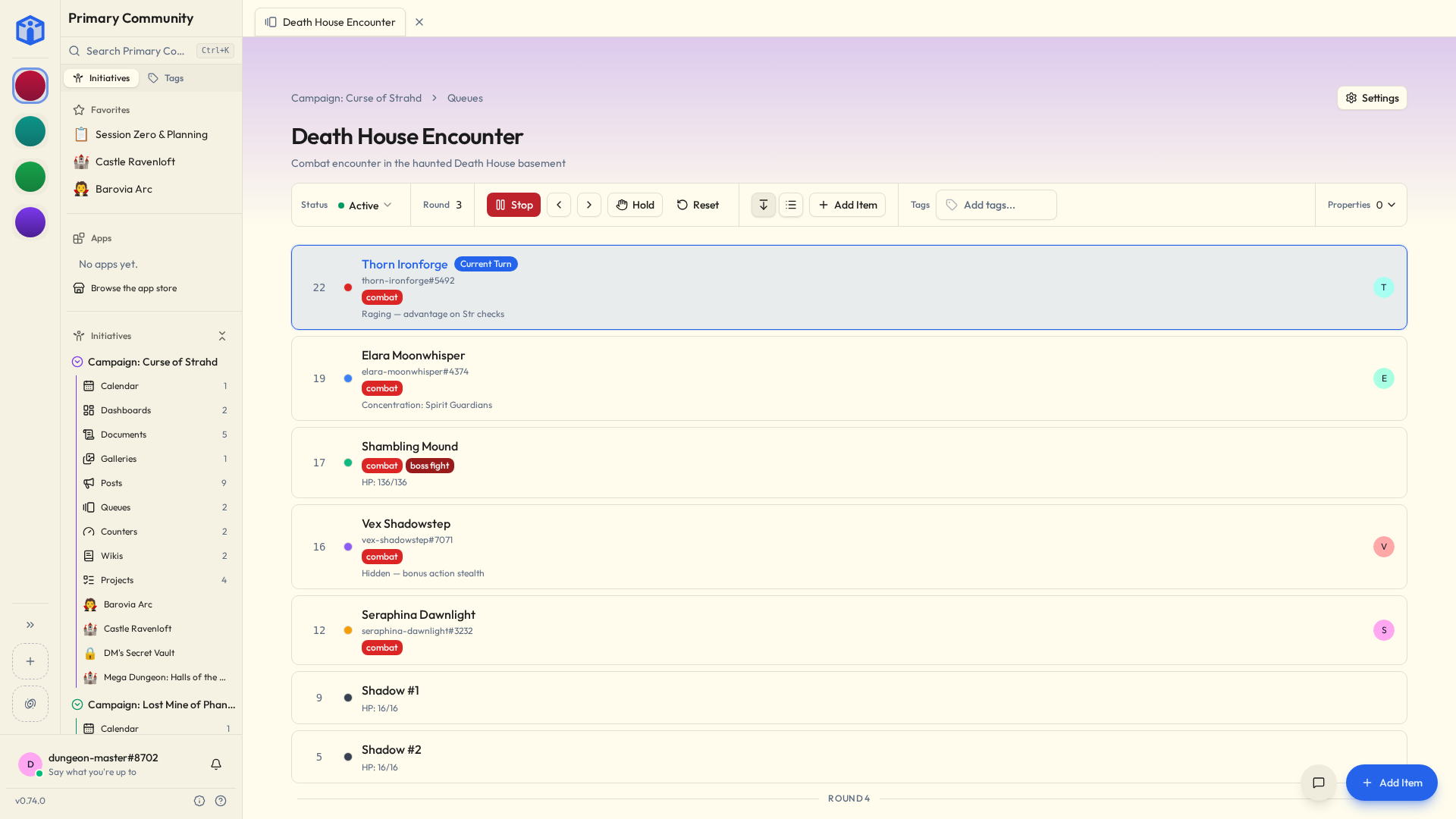
The controls sit in the strip at the top of the queue, beside its status and tags. Start the queue and it begins tracking. From there:
- Next Turn and Previous Turn step through the order.
- Hold parks the current turn without losing the place — the person stepped out, the item isn't ready, the answer is "not yet". When they're back, Act takes their turn, either at their old place in the order (Act in place) or right where the queue is now (Act and reposition).
- Round counts how many times you've been all the way round, which is the number people usually actually want.
- Reset starts it over from the top. Stop pauses it until the next time it's needed.
In the list of queues, each card shows whose turn it is and who's next, so a glance at the initiative is enough.
Hidden items still hold their place
Marking somebody hidden takes them off the display without removing them from the order — right for the volunteer who's away this month and back next. Delete them only if they're actually gone.
Duplicate, in an item's edit window, adds another just like it at the same place in the order, with "(Copy)" on the end of its name. That is the second goblin sorted.
Things people use them for
- On-call rotas — who's carrying the phone this week.
- Speaking order — meetings, panels, table reads.
- Chores — the wheel everybody enthusiastically agrees to in January and nobody can recall by March.
- Turn order — tabletop games, tournaments, anything with a round in it.
- Duty rosters — front of house, driving, unlocking the hall.
- Whose turn it is to email the council. Nobody's turn. It's always nobody's turn. Put it in a queue.
Sharing and comments
Queues share exactly like every other tool: per-queue access at Viewer, Editor or Owner, or open to everyone in the initiative. Tags, comments, connections, copies and changing access on several at once all work the way they do everywhere — see Tools.
Related
- Tools — what every tool shares.
- Sharing projects & files — the access levels in full.
- Tags — labeling queues and their items.
- Your space — every queue that's reached you, from every community, in one table.