Welcome to Initiative
Initiative is where your group's projects, tasks, files and plans all live in one place.
Right now they're living across a group chat, two spreadsheets, an email thread from March, and the head of whoever's been doing this the longest.
We know about the spreadsheet. We know about the merged cells. We know somebody colour-coded it in 2019 and nobody now remembers what green means. It's fine. We're here now.
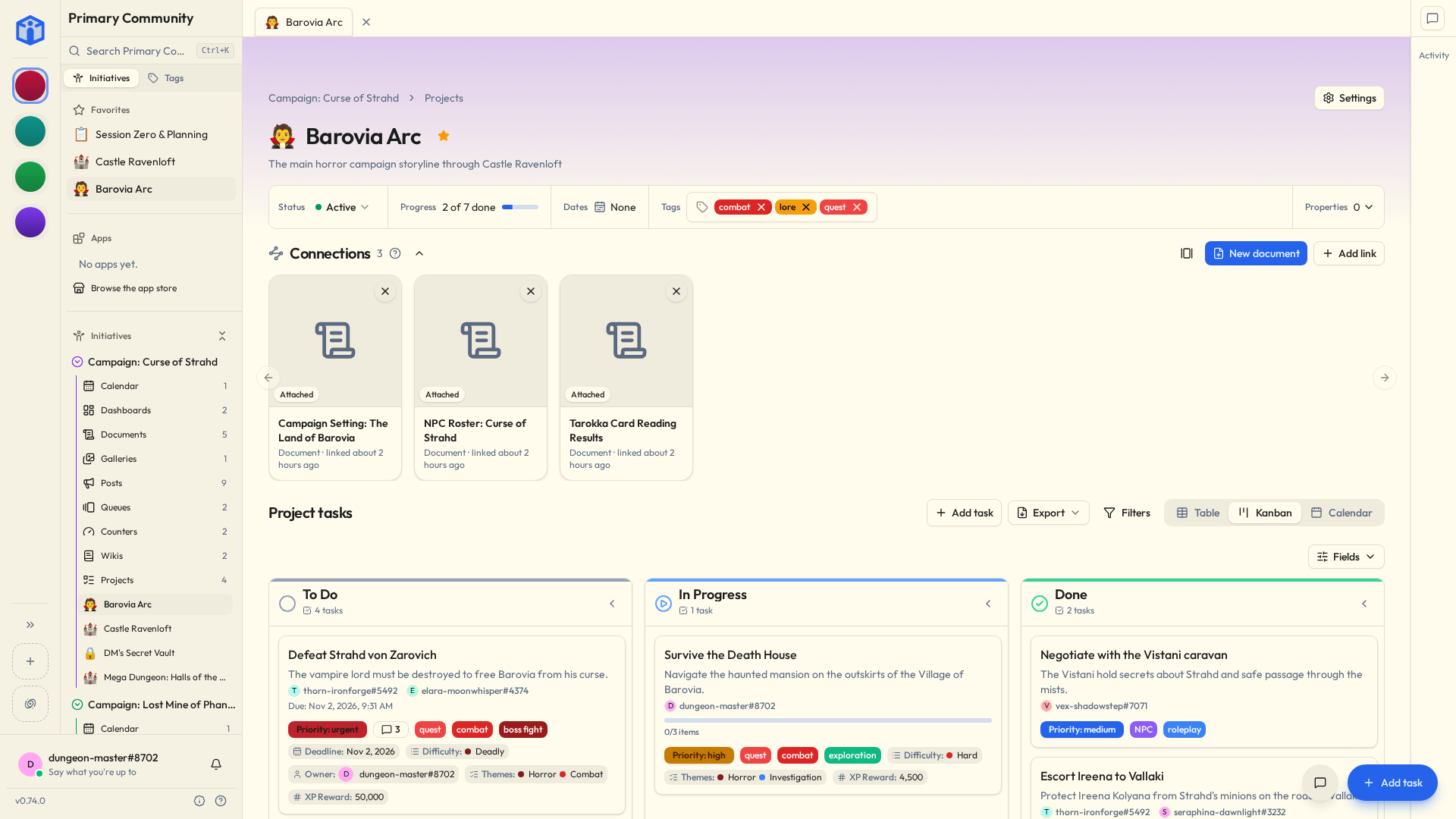
Start small. No, smaller than that.
Day one: make one board, put a few tasks on it. Done. That's a complete setup — a real, functioning system — and if you never touch another feature you'll still be dramatically better off than you were on Tuesday.
Everything else is already installed and waiting. Files, a calendar, dashboards, the lot. None of it will bother you, email you, or pop up to ask whether you've considered optimising your workflow. It has nowhere else to be.
You cannot break this
This is the thing people actually worry about, so let's clear it up first.
- Deleted something? It's in the Trash, sulking. Go and get it.
- Moved a task somewhere daft? Move it back. Nobody saw.
- Made an initiative you didn't need? Archive it. It leaves your life entirely and does not write.
- Made a project called "test"? Everyone does. It's still there, isn't it.
- Made four projects called "test"? Also fine. Marginally funnier. Still fine.
There is exactly one genuinely permanent button in this entire application, and it makes you type things out longhand to prove you meant it. Everything else survives being dropped down the stairs.
So click things. Open menus. Drag stuff about. The worst outcome available to you today is a mildly untidy sidebar.
We say no to things
Initiative is meant to help you, not to gradually become the tool with so many features that operating it is its own part-time job.
So some things are left out on purpose. The conversation about your work happens in comments, for instance — on the thing it's about, where the next person finds it without being told where to look, and searchable when they half-remember it six months later.
Which is not where it ends up in a chat room. There, somebody pastes the thing that should have been a document, and six months later everyone is scrolling for it, and Jenny has left, and somebody is looking at the printer in a way the printer has done nothing to deserve.
Two ways to run it
Host it yourself — open source, free, the entire product, running on whatever machine you've got going spare. A ten-year-old laptop with a broken hinge is a perfectly respectable server.
Or let us host it (soon) — pay us and never think about a database again, which is an extremely reasonable thing to want and quietly the correct answer for most people.
Same software either way. We're not keeping the good bits back for the paying customers. Which one is you? →
Find what you need
-
Getting started
Make an account, find your way around, join your group.
-
How Initiative is organized
Communities, initiatives, projects, files — what they are and how they fit together.
-
Using Initiative
How-to guides for projects, tasks, files, the calendar and everything else.
-
Plug-ins & the marketplace
Ready-made dashboards and plug-ins, built by groups like yours.
-
Sharing & access
Decide exactly who sees and edits each project and file.
-
Security & privacy
What "secure" means for you, and how your group's stuff stays yours.
-
Running a server
Installing, configuring, and looking after your own server.
-
FAQ
Quick answers to the things people ask most.
You choose who sees what
Nothing here is visible to "everyone" by default, and there's no buried setting you have to find to make that true. Your group's space is separate from every other group's; inside it, each effort is only visible to the people you put in it; and any project or file narrows down further still.
Which is how the payroll planning stays away from the seasonal staff, and next year's programme away from this year's volunteers — same workspace, nothing configured, nobody wandering into a folder they were never meant to see. How that works →
The tools come from people like you
Whatever your group needs, some other group has needed precisely the same thing, built it, spent three years rebuilding it by hand every January, finally snapped, and shared it.
That's the marketplace: ready-made dashboards and plug-ins, about two clicks each. It's curated rather than open season — yours holds what ships with Initiative plus whatever the person running your server approved. See Plug-ins & the marketplace.
Why we built this
We're self-hosters. We got here the way most people do: by slowly going off the tools we relied on, as it became clearer what they were doing with the things we put into them.
What tipped it was watching creative work get hoovered into training data by companies that never thought to ask. To be clear, we like AI. We use it. But being useful doesn't entitle anyone to take what somebody made and feed it to a machine — and once that's happened to something of yours, "we promise not to" stops sounding like much of a promise.
So we treated it as an architecture problem rather than a policy one, because a policy lasts exactly as long as the person who wrote it stays in charge. Nobody running the server holds standing access to a community's data. Reaching into another community takes a time-limited grant that leaves a record. Direct messages are encrypted well enough that no key to them exists outside the two phones talking. We locked ourselves out on purpose, and we'd do it again.
Which means we can't feed your work to a model, because there's no pipe to put it in. The AI features that do exist are ones you point at your own stuff deliberately, and they send only what you asked — under that provider's terms, which we'll tell you to go and read rather than pretend we control. See AI features.
A note on the words we use
Initiative takes two perfectly ordinary words and gives them specific jobs. Sorry.
- A community is a workspace — one separate space for one group of people. Your book club and your work team are two different communities.
- An initiative is a folder for a big effort inside a community.
And yes, the app is also called Initiative. We know. The glossary covers the other words we've bent to our own purposes.
For the technically minded — what this actually is
Initiative is a web application you can run yourself. A single-page web app talking to a Python service backed by PostgreSQL. Each community gets its own database schema, so a request in one community cannot address another community's tables at all; the finer layers inside a community — which effort, which role, which item — are enforced by the database's own row-level security rather than by application code. There are companion apps for Android and for Windows, Mac and Linux, and the web app installs itself on an iPhone or iPad from the browser. More in Security & privacy and the server guide.
Built in the open
Initiative is developed in public, and what people using it say genuinely shapes what gets built next. So if something here is unclear, wrong, or conspicuously missing, tell us — the project's on GitHub, and we do actually read it.